


Every time I make ghee I wonder how it was invented. Perhaps someone left some butter cooking on the stove by mistake … Ghee is not so well known in our culture but is widely used in many countries especially in India. It is called drawn oil in English and is served with steamed lobster and crabs in the United States. Chefs like to use it because it has a high boiling point so it does not burn easily. In fact, ghee is one the best cooking oils. In addition to its convenience, people in India use it for its numerous health benefits and is considered to be a sacred food.
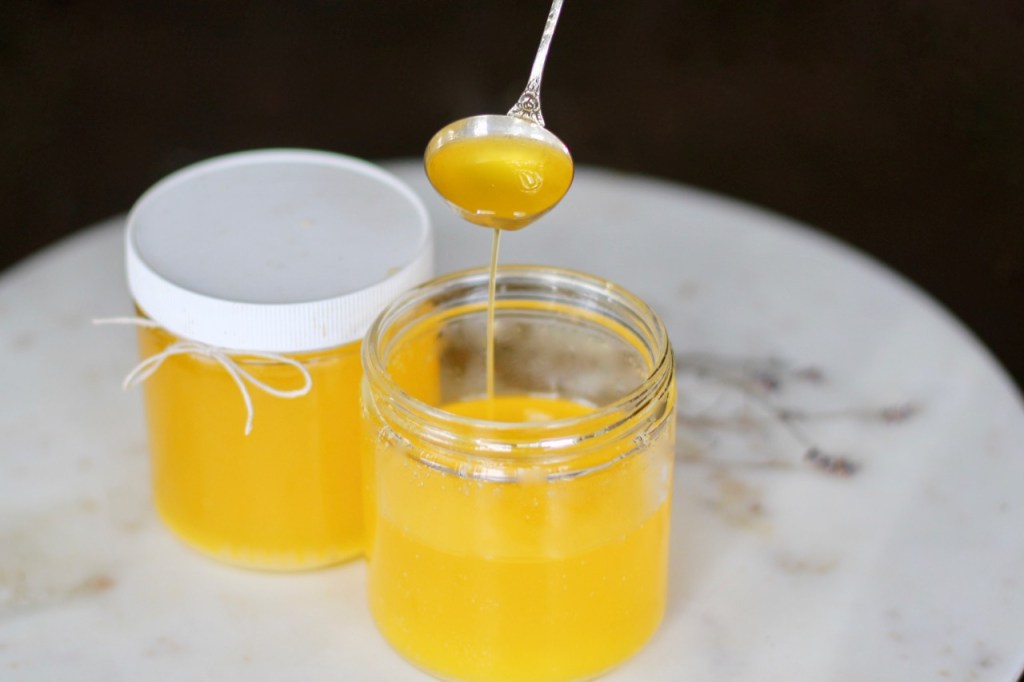
What is ghee? Ghee is basically butter with the milk solids removed resulting in clarified butter. It is made by gently boiling butter and removing the separated milk solids that are formed during the process. Ayurveda, the ancient Vedic Natural Medicine of India, believes that the milk solids are toxic and should be discarded. In the absence of the milk solids, butter is more suitable for cooking at higher temperatures and is better for health.
So why should one make ghee?
One, it is cheaper. If you make it yourself, it is half the cost of the store bought ones or might be even less. Also, I like to know what is in my ghee. The store bought ones are definitely lesser quality even when you buy the organic ones. When you make your own, you have control over what butter is used. After all, ghee is all about being a healthy alternative to butter. And it is easy to make for sure. I just cook it on one of the back burners during breakfast or while I’m making dinner.
What do you need to make ghee?
You will need a pot with a heavy bottom to prevent butter from burning. In addition, you will need a strainer and a cheese cloth that will help you remove the unwanted protein. You will also need jars to store ghee. 1 lb of butter yields 1/2 quart of ghee. Try to use a jar with a wider mouth that is not too deep.
How can you use ghee for?
Of course, you can use it to make Indian dishes as they generally call for ghee. It can also be used any time when the recipe calls for butter. I like to use it for baking pancakes. It is great if you are like me and prefer your pancakes to have that nice buttery flavor and you don’t want to worry about burning the butter. In addition, as I have mentioned before, it is used as a dipping sauce for steamed lobster and crabs. Feel free to experiment and include it in your cooking any time.
So let’s look at all those claims, I’ll try not to be too long. Ghee is considered to be a big health remedy in Natural Medicine. In Ayurveda, it is considered to be pitta and vatta pacifying which means it is good for hot conditions like inflammation and also dryness when nourishment is needed in the body. It is great for the entire body from the joints, tissues, digestion to the nervous system and many more. In addition, it is especially a great remedy for longevity.
It is great for digestion. The big issue with fats is that they can slow down digestion. Well, ghee actually helps this process as it increases the digestive fire and enhances absorption and assimilation so it can even be used by kapha type people. Kapha type people are individuals whose digestion tends to slow down by oils and they can gain weight easily. These people are advised to use ghee as an oil in moderation -of course. It keeps the gastrointestinal tracts healthy, thereby helping digestion. Also, people with dairy allergy can often tolerate ghee without problems.

RECIPE
Ingredients
1 lb of organic unsalted butter (possibly grass fed)
Preparation
- In a medium sized pot with a heavy bottom, start melting butter at medium high heat. Set your burner to 2-3 on your stove but try to find the appropriate temperature. Make sure the butter does not burn. After the melted butter starts bubbling, cook it for another 10 minutes on medium low heat. It will start turning a lovely golden color with whitish particles that kind of look like popcorn.
- Do not cover the pot because the liquids need to evaporate from the butter.
- The butter will foam and sputter for a while and then start quieting down. You can stir the mixture but I haven’t seen any difference when I don’t. When done, turn the heat off. I let the mixture cool for 5- 10 minutes and strain off the solids. When you let it sit, the solids will settle on the bottom of the pot.
- Line a fine strainer with a double layer cheese cloth and set them over a bowl. Pour the melted butter through the cheese cloth into this bowl. Discard the separated solids. Pour the clarified butter into the jar.
- Store in a cool, dark space. It can keep for up to one year.
Source
Vasant Lad: The Complte Book of Ayurvedic Home Remedies
 Twin Cities Herbs