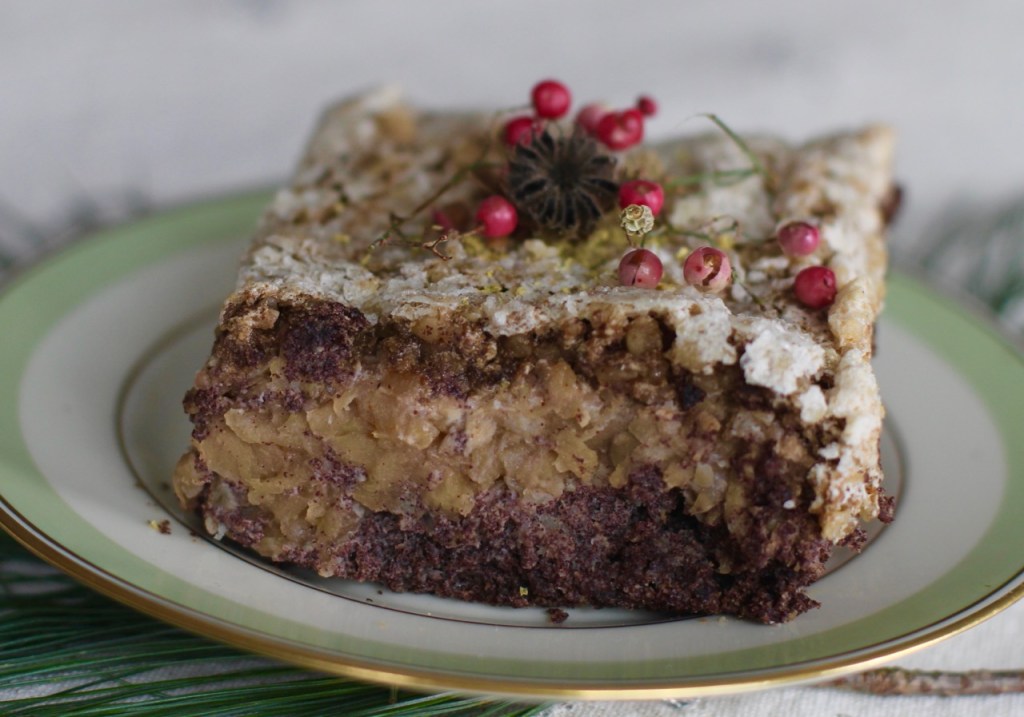
Flódni is a unique traditional Jewish Hungarian dessert. This original recipe uses apples, poppy seeds, walnuts, plum jam and all these ingredients are baked into a flour crust. This recipe uses the three main ingredients: apples, poppy seeds and walnuts plus the plums but has no crust. It is a gluten free recipe, in fact it is a very clever gluten free twist to the original recipe as the carbohydrates come from the poppy seeds. Its sour, bitter and sweet flavors come together to give a distinct culinary experience.
Traditionally, it is made at the end of the year for Christmas and Hanukkah but can be eaten any time during the year. It is filled with symbolic meanings for the end of the year. Each layer is rich and decadent and according to folk traditions can supposedly bring prosperity, health and protection for the entire family.
I was inspired by the recipe that came from a website – credited at the end. I have been making this delicious alternative at Christmas time for years. I made some changes to the original recipe. I moved some sugar from the nut filling into the poppy seed filling. I also added plums to the poppy seed mixture and some alcohol to the apples. Oh and honestly adding a little ginger to the walnuts did wonders.
RECIPE
INGREDIENTs
Ingredients for the poppy seed layer
200 g (about 1 cup) poppy seeds
1 Tbsp melted butter (coconut oil for dairy free version)
3 eggs, divided
1/2 cup sugar
handful of raisins
1 orange or 1/3 cup orange juice + 1 Tbsp dried orange peel
Ingredients for the apple layer
1 kg (about 7 larger) tasty cooking apples
1 Tbsp fresh chopped ginger or 1.5 tsp dried ginger ( cut and sifted)
4 Tbsp sugar or honey
1 tsp ground cinnamon + 1/4 ground cloves
pinch of salt
2 Tbsp rum (optional)
Ingredients for the top egg-white layer
150 grams (5 oz) ground walnuts
4 egg whites
1/4 – 1/2 cup sugar
1 tsp fresh ginger or 1/2 tsp dried cut and sifted ginger
salt
METHODS
Preheat oven to 300 F (150 C). Lightly butter a baking pan (8 x 11.5 x 2″).
Preparing the poppy seeds
Grind the poppy seeds. (Coffee grinder works well).
In a smaller bowl, mix the ground poppy seeds, melted butter, sugar, 3 egg yolks, plums, raisins, orange juice and peel, pinch of salt. Set aside.
Beat the 3 egg whites until stiff. Gently fold the beaten egg whites into the poppy seed mixture from earlier.
Spread the poppy seed mixture onto a lightly buttered baking pan.
Preparing the apples
Wash, peel and core the apples. Grade them through the large holes of a cheese grader. Put the grated apples in a medium sized pot and cook it in a large pot on high medium heat until the liquid evaporates. When done add rum, ginger, ground cinnamon and cloves, pinch of salt and 4 Tbsp of sugar/honey. Set aside.
Spread the apple mixture on top of the poppy seed mixture and place the dish in the preheated oven. Bake for 40 minutes.
Adding the nut mixture
Walnut/egg white topping: Have the ground walnuts ready. By the end of the 40 minutes, beat the 4 egg whites until stiff. Gently fold in the walnuts and the sugar. Spread this mixture on top of the apples and put the dish back into the oven. Decrease the temperature to 250 F (120 C). Bake for another 30 – 40 minutes.
Let it cool and settle. Serve at room temperature.
Beigli is a popular savory pastry made with a sweet yeast dough that is filled with a poppy seed or walnut filling. I used poppy seeds in this recipe. The floral, earth flavored poppy seed is a popular winter food. I can’t imagine winter especially Christmas without it. Particularly, poppy seeds symbolize health, fertility and prosperity that are important themes for the Christmas and winter solstice celebration.
When I got married there were two desserts that I was able to make. One for the summer and the other for the winter. Of course, beigli was for the winter. Not sure how this worked out but I’m guessing it is because there is no Christmas without beigli and my husband picked up the tradition very quickly as well. I have to let you know that it takes 4 hours to make this dessert.
There is a little history. Poppy seeds have been an important staple in the Hungarian cuisine. Beigli has been around for a while but no one knows the exact story behind it. One possibility is that it had originated in the old Hungarian city of Pozsony, today known as Bratislava that is now in Slovakia. Beigli started appearing on the Christmas tables only about 200 years ago. Hungary was part of the Austro-Hungarian Empire at that time so it makes sense that so many other Central European countries make it for Christmas as well.
Some facts
Poppy seed is native to Western Asia and has been around for thousands of years… perhaps Hungarians had picked it up when they lived near Turkey.
It is considered a significant source of food from carbohydrates, is abundant in vitamin B complex and E, iron, calcium, phosphorus and is rich in fatty acids. It is considered soothing and calming, boosts the immune system, supports brain, bone and heart health and can be helpful in the treatment of certain cancers.
Ancient Chinese Medicine considers it to be sour, neutral in energy and is associated with the Lung, Large Intestine meridians. It has a kidney shape and is believed that it is beneficial for the kidneys.
Ayurveda, the ancient healing system of India believes it is beneficial for digestion and nourishes body fluids and the nervous system. Maybe a nice remedy to keep you calm during the holidays! Oh and it is also aphrodisiac!
You will need to get a lot of poppy seeds.
The little bottles that they sell at the supermarkets will not be enough as this recipe requires 10 oz. I purchased mine at Penzeys but you should be able to find it in many smaller grocery stores.
When I got poppy seeds recently at Penzeys’, the clerk checking me out reminded me that poppy seeds needed to be stored in the freezer if not used up. Poppy seeds go rancid easily because of their high fat content. I told her that this will not be a problem because we eat it fast. Her mouth just dropped open … I bought 1 lb. Just warning you, you will need to get a lot of poppy seeds, I know people in the US are not used to using so much.
The seeds will need to be ground as well. I have a Vitamix that grinds poppy seeds well. If you don’t have one, no worries! You can also use an electric coffee grinder. Supermarkets do sell canned ground poppy seed mixed with the sweeteners, flavorings, preservatives etc but you will not get the same results with those.
How can the dough crack?
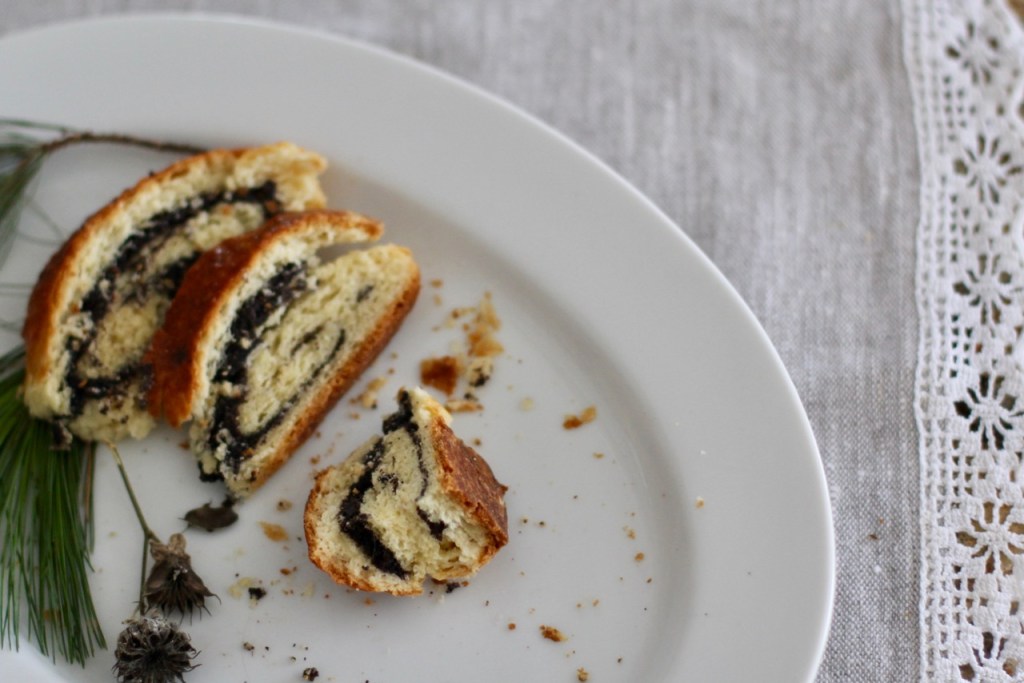
Hungarians are always worrying about cracks in the crust. If you follow my recipe below, you should be fine. However, the tastiest beiglis I have eaten were slightly cracked, like the one on the picture. I chatted with my kids and let the dough rise too long … but everybody commented it was one of the best I have ever made. They wanted to know what I did differently … My mom will probably comment on the appearance of my beigli but oh well. So there are some rules on how not to get cracks. For the records here they go …
Crust can crack if
the dough was left to rise too long
too much filling or sugar was used
work area was too warm
dough was not pricked on the sides
RECIPE
Family recipe
Ingredientsfor the dough
500 g (4 cups) of organic flour (I used Bob’s Red mill)
25 dkg (18 Tbsp) butter
2 tsp dried yeast
2 large eggs
3-5 Tbsp sugar, regular granulated or powdered
1/2 cup (1 dl) of milk
1/8 tsp or pinch of salt
pinch of nutmeg (optional)
Ingredients for the filling
30 dkg (2 1/4 cups) poppy seed
3 dl (1 1/8 cup) milk
1 cup of sugar
peel of 1 orange or lemon or 3-5 Tbsp of dried peel
1 Tbsp of flour
1/2 cup of raisins or chunks of plums (you can leave it out if disliked)
1 tsp vanilla extract
pinch of salt
Preparation
Have all ingredients at room temperature.
Preparing the dough: Get the yeast started in the warm milk (104 – 108 F). This is a temperature that should feel neither hot or cold on your wrist or when you stick your index finger in the solution. Dissolve the yeast in 1/2 cup of warm milk with 1 tsp of sugar, stir and cover for 5 minutes or until yeast comes up to the top. Meanwhile start sifting the pinch of salt and 3 Tbsp sugar into the flour. Then cut butter into the flour mixture until it resembles course crumbs. Add the eggs and the yeast mixture and quickly mix until a ball is formed. Let it rise for 2 hours, cover with a damp cloth.
Preparing the filling. Start preparing the filling right away because it has to cool. I would not make it ahead of time because it can dry out. If you start it right after you finished the dough, it should be fine. Grind the poppy seeds (please see above). Boil the 1 1/8 cups of milk, add the ground poppy seeds, orange peel (for me the more the better, I used 5 Tbsp of orange peel), sugar, flour and raisins. Mix and set it aside to let it cool.
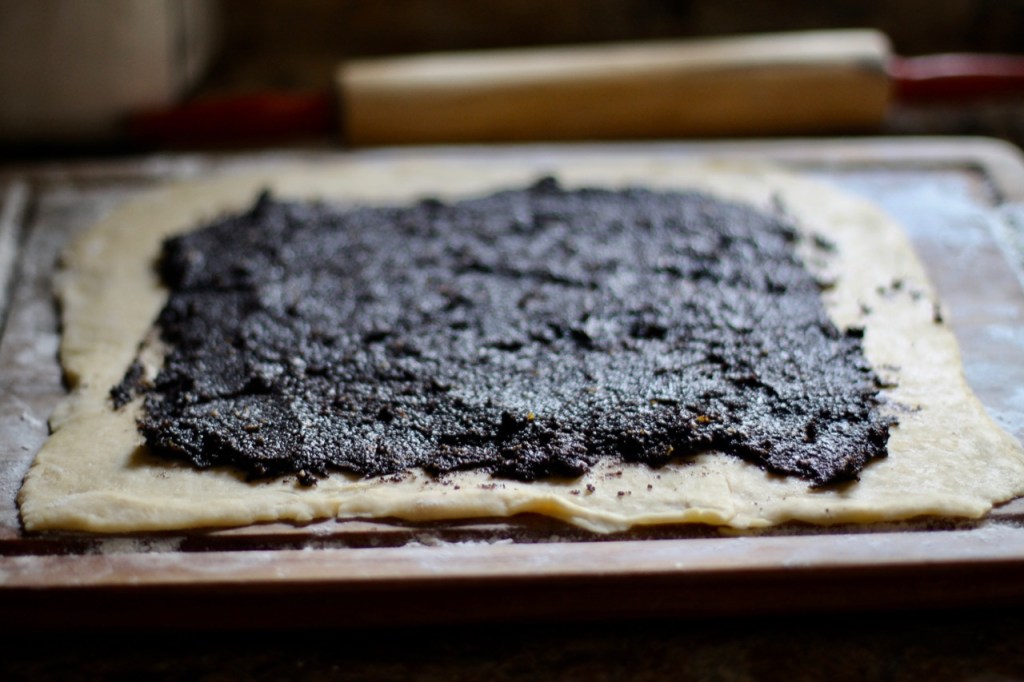
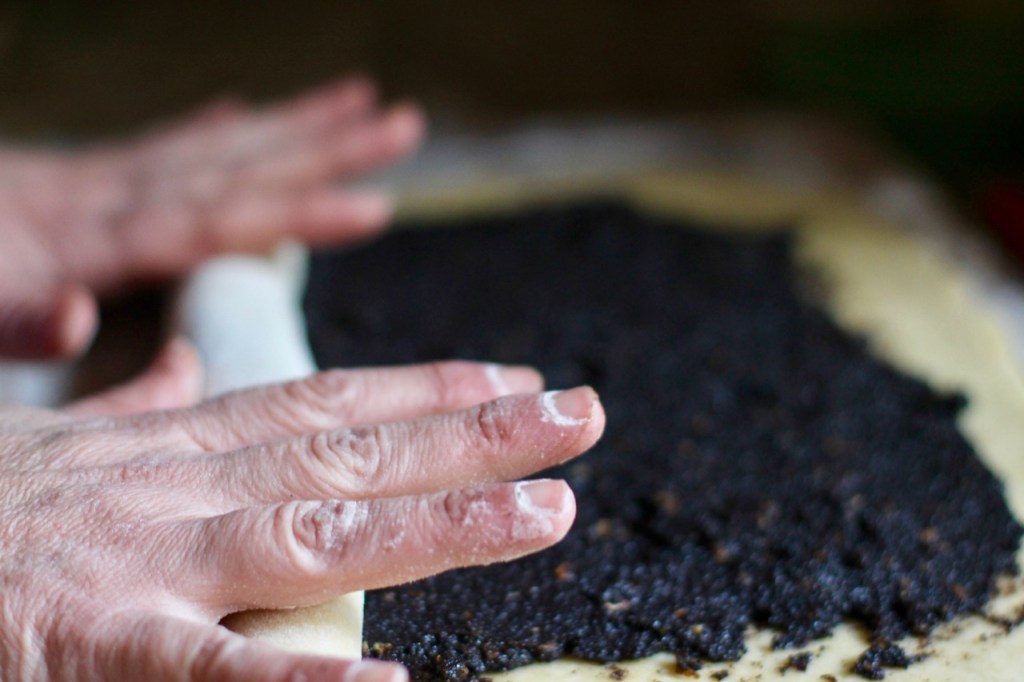
Assembling the rolls. Turn the dough onto a lightly floured work surface and kneed shortly until they are smooth. Divide it into 2 bigger or 4 smaller pieces. For me it is too hard to get 4 equal sized balls so I either do 2 or 3 ball. Roll them out into a rectangular shape and spread half, third or quarter of the filling, respectively in about 0.5 cm thickness on the dough leaving about 1 inch from the edges. Please see picture for clarity. Start rolling the longer side not too tight but not loose either. Pinch the two sides so the filling can’t come out on the sides. Repeat with the others. Put the rolls on a lightly buttered cookie sheet so the rolled up edge is on the bottom of the cookie sheet. Do an egg wash with 1 egg and let the rolls rise in a coolish place (60 – 68 F) for 1 hour. Note the kitchen might be too hot for this step. Then spread 1 egg white on the rolls and cool in the fridge for a half hour. Preheat oven to 375 F. Before I put the rolls into the oven, I do another layer of egg white wash and prick the side on the sides 6-7 times to prevent cracking.
Baking the rolls. Bake in the preheated oven for 25 – 30 minutes. Take out when done or when the surface has a beautiful golden finish. Try to avoid opening the stove door. Wait a good 20 – 30 minutes before cutting the slices.
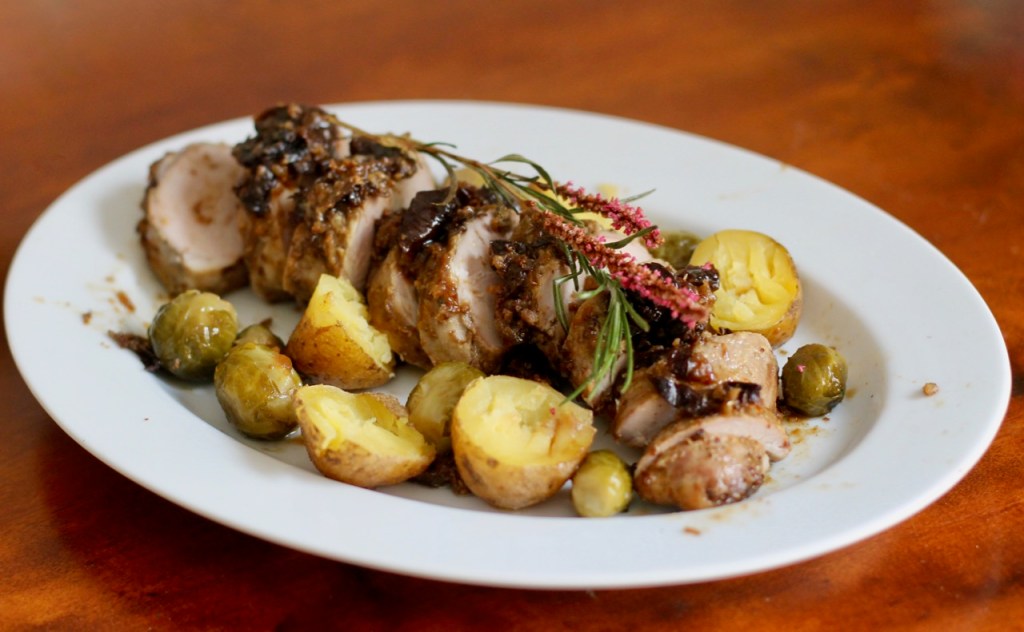
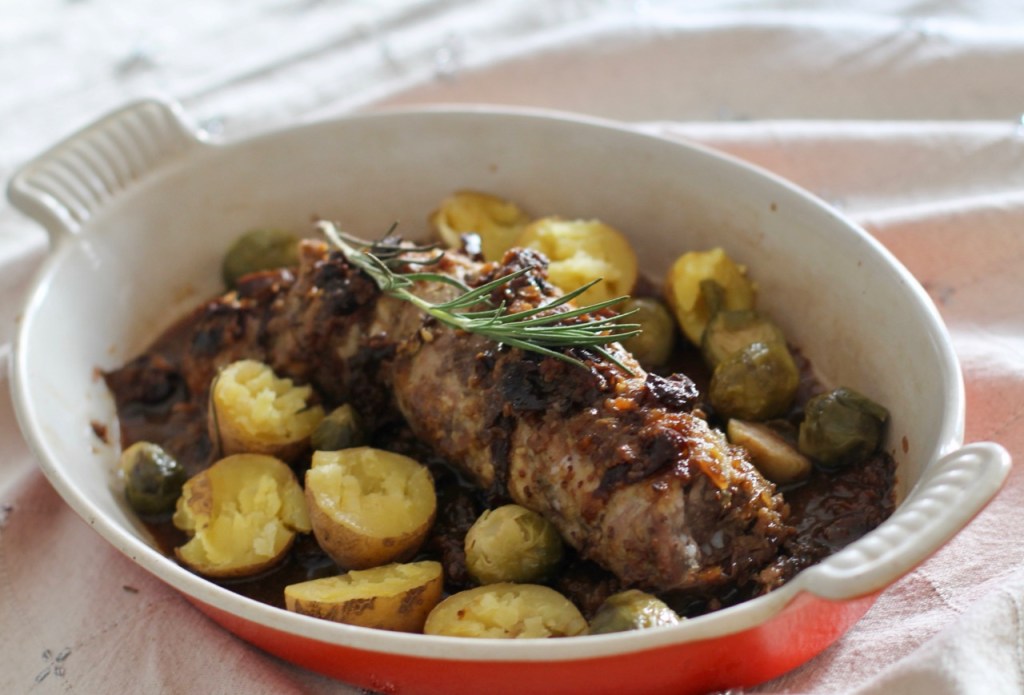
It is December now and I am already missing the plums from this summer. Then I happened upon this recipe (source of the recipe) … a dish with pork baked in prune sauce! I really like to prepare meats with fruits and the prunes work nicely with the pork here. Oh and that savory aroma of the prunes cooking with the shallots!!! … I decided that I will be making this recipe for Christmas Eve. I believe it would be perfect for this busy night. It can be marinated ahead of time and then just has to be cooked on the 24th … and after eating this dish I might have visions of sugar plums dancing in my head…
I really like simple meals that have an interesting flavor and this dish does just that. The pork is first marinated in a mustardy sauce and further baked in a savory plum sauce to perfection. The moist pork works nicely with the sweet prunes along with pungent spices and results in a unique sweet and savory flavor. Of course, it needs to be served with some nice wine or grape drink.
I made a few minor changes to the original recipe. I added a little red hot pepper, of course it is optional but for me, some spiciness was missing. I felt that the sweet pork along with the sweet sauce needed a touch of spiciness to balance the dish out. Not sure if it is authentic but this was more to satisfy my personal taste.
Also, I served this dish with brussel sprouts in addition to the potatoes. I served brussel sprouts but any other bitter green leafy vegetable like kale, lettuce would work well. Also, the recipe calls for 2 cups of chicken stock. You can do half white wine and half chicken stock if you wish.
If you can’t find tenderloin or just don’t want to spend so much money, sirloin is a nice alternative. Sirloin, a different part of the pork, is not as tender, will require longer cooking time and more cooking liquid. (I cooked it for 15 minutes longer and added an extra 1/4 cup of chicken stock). Honestly, they both taste nice though. Of course, if you want to impress your guests, or just treat yourself to something special, the tenderloin is more superior in flavor so go for the tenderloin!
A few words about the pork. It is sweet and salty. According to Ancient Chinese Medicine, pork is great for the fall and the winter as it is moistening. In fact, pork is moistening for the lungs, kidneys, and the spleen-pancreas. In Europe, it is a popular meat during the cold months especially during Christmas time.
Recipe
INGREDIENTS
1 pork tenderloin (approx. 1.25 pounds) or sirloin 2 TBSP brown sugar 1 TBSP Dijon mustard 4 tsp extra virgin olive oil, divided 2 cloves of garlic, minced + 4 whole cloves, peeled and slightly smashed 1 tsp fresh thyme, chopped (or 1/2 tsp dry) 1/2 tsp salt 1/4 tsp pepper 10 dried plums (prunes), chopped in half 2 smaller shallots or 1 bigger one, peeled and thinly chopped 2 cups chicken or pork broth or 1 cup of chicken/pork stock and 1 cup of white wine 1 TBSP red wine vinegar fresh parsley
DIRECTION
Marinade: In a small bowl mix sugar, Dijon mustard, 2 tsp olive oil, thyme, sale, pepper and 2 cloves of garlic. Put the mixture on the tenderloin, evenly spreading it all over the pork. You can put the pork in a zip lock bag or a marinating dish with a lid. Let it marinate in the refrigerator for 4-6 hours.
Preheat the oven to 375 F (190 C). Take the pork mixture out of the fridge and let it come to room temperature.
Prune sauce: In a pan with oven proof handles, gently heat 2 tsp of olive oil, add shallots and stir. Cook until it start becoming soft and you can smell its aroma – about 5 minutes. Add the garlic, the chopped prunes and stir … Now if I may, I would like to invite you to stop for a few seconds and smell the aroma of the shallots, the garlic and the prunes, it is amazing … after 1 minute add the chicken stock, vinegar and hot pepper (optional). Cook for 5- 10 minutes.
Place the pork in the middle of the pan. Put the pan into the pre-heated oven for 15 minutes. Cook for an additional 20 – 25 minutes basting 2-3 times or until the meat is 160 F.
When meat’s temperature reached 160F, take the pan out of the oven and cover. Let it rest here for 10 minutes before you start slicing them.
Serve sliced with potatoes, brussel sprouts and some wine. Drizzle the sauce on the top.
Winter is rather a complex and mysterious season. It is more like cold and darkness desiring warmth.
When I’m out in the woods in the winter, it is so quiet, I can hear every step, every movement. I always wonder about what is inside the Earth and deep inside the lakes. It is almost like you can hear it. It is so mystical. Where are all the plants and animals? As a great Hungarian poet, Petöfi Sándor put it “Nature doesn’t die, it is just sleeping”.
Winter is an auspicious time of the year for sure. In the absence of many distractions, our life quiets down. We naturally tend to turn more inward and spend time in the quiet. With the scarcity of warmth and light, we start acknowledging them more. We bring them into our lives by making bon fires outside, lighting candles or by sitting by our fire places.
In Chinese Medicine, each season is associated with a natural element so winter is associated with water. Also, each element has corresponding western organs. The Western organs of the Water element are the Kidneys and the Bladder and in addition, the Adrenals’ and the Sexual organs are also included. (I capitalized the organs because in Chinese Medicine, it is more like an organ is considered to be the organ itself and its energetic functions).
Let’s look at what the Kidneys do in our body. The Kidneys provide warmth and moisture and are the source of vitality. In addition, the Kidneys ‘govern’ water metabolism and control’ the Bladder. Salty (pork, salt, sea weed, barley) and warming foods (squashes and root vegetables) support these functions. For vitality, it is essential to avoid too much stress and try to rest more, curl up on your sofa and read a book or do whatever your heart is desiring.
It is important to keep the Kidneys healthy during the winter months so they can perform these functions now and later the year. Major consideration for the winter months are cold, dryness and stress. It is a great time for eating nourishing, warming foods like bone or vegetable broths, meats and beans especially kidney, aduki and black beans. The Chinese and many other cultures take their nourishing, rejuvenating herbs at this time. As we are preparing for the holidays poppy seeds, walnuts and pork come to my mind.
In addition, the following foods are also great to nourish the kidneys: millet, barley, mung bean, potatoes, spirulina, cheeses, fenugreek seeds, cinnamon bark, cloves, onions, quinoa, lamb, salmon, trout, wheat berry, sweet rice, animal kidneys, almonds, royal jelly, bone marrow soup, butter, ghee, chicken liver, chestnuts. Oh and let’s not forget the cranberries!
Paying attention to our cooking and eating methods could help us get through the harshness of the cold winter easier. Just like the trees that move their sap deep down and inward, so too energy in humans should have the same movement. The flavors of the winter, bitter and salty (of course in moderation) should facilitate this sinking, downward moving and storing energy.
The bitter foods help the body’s energy to sink downward and get the body ready to store food. Winter bitter foods are oats, rye, quinoa, kale, celery, turnips, cranberries, citrus peels. Salty foods are able to move energy inward concentrating warmth inside while keeping the outside slightly cool. Salty flavor also keeps the kidneys stay moist and healthy so they can promote fluid metabolism. Salty foods include pork, barley, seaweed, salt.
Winter cooking method should focus on storage and moving energy inward. Mainly cook your foods longer at lower temperatures and use less water. Try to avoid ice, raw and greasy foods, excessive salty and bitter foods and over-eating.
If you are looking for dishes to make during the winter, please, click on the winter ‘keyword’ on the right and you should get all my winter recipes.
Apple pie is a special American dessert. I have always wanted to make it ever since I took the first bite of my mother-in-laws home-made pie like 25 years ago but I was somehow afraid of making it. I even gifted a pie form for my husband’s birthday 15 years ago to make sure that I make it. Ok so a few years ago I ventured into making one from a recipe I found online. I thought all apple pie recipes were the same … hmmm not true it didn’t turn out good, in fact it was terrible. Then, I found Martha Stewart’s pie recipe … and it was a huge success. I felt such a great accomplishment after I made it. Here I have the full proof Martha’s apple pie recipe so you don’t have to hunt for a good one.
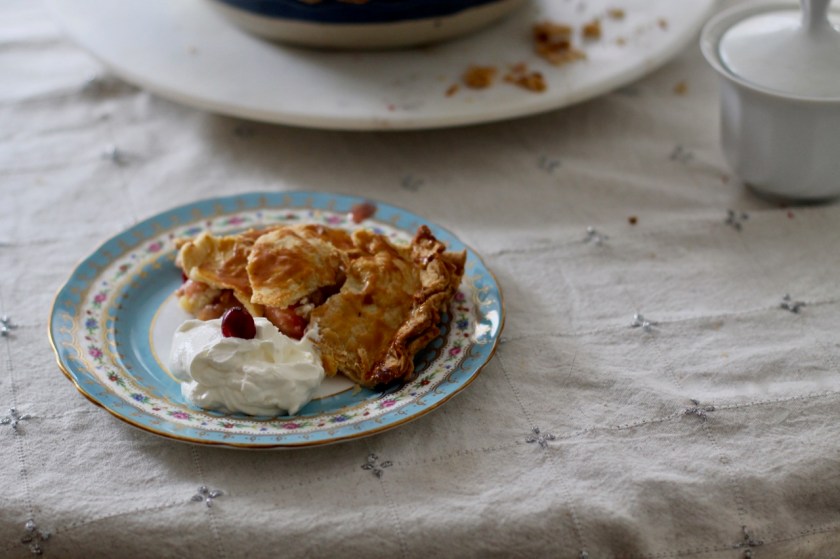
The apple pie is an important part of the Thanksgiving dinner for many people. The delicious savory apple filling is wrapped in a flaky buttery crust and is served with whipped cream. I used Martha Stewart’s basic apple pie recipe and added cranberries. I think the tart and sour cranberries elevate the pie to another level. If you prefer to leave out the cranberries, add an extra apple to the filling so instead of using 6 apples and 1 cup of cranberries, use 7 apples.
According to Martha Steart, there are three basic rules for making a fabulous apple pie: Use the best ingredients, keep the dough cold and when you handle the dough less is more. Have fun making the pie, it is so worth it!
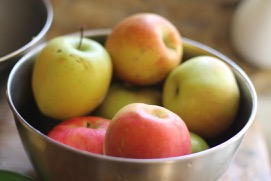
As Martha Stewart says you should get the best ingredients for your pie in other words your pie will be only as tasty as the ingredients are. The most important part of the pie at least as far as taste goes is the apples. When I go to the farmers’ market to get my baking apples, they always give me a mixture of apples. In fact, the lady at my favorite stand always gives 7-8 different apples. So how do you select the right apples?
Basically you want baking apples that are firm and keep their shapes while baking. The best apple for this is the Granny smith. If you like your pie more tart you can just use this variety. OK I know some people want more of a sweet apple pie. There are many other apple varieties that would make the pie sweeter like Cortland, Braeburn, Regent, Harlson. And I always like to add one very sweet one like Fuji, Honey crisp. Once you decide on the type, make sure they are also tasty. It is hard to describe but they should have a zesty flavor. When you try it you know what I mean! Sorry to say but supermarket apples often don’t have this. I personally like to get local apples for this purpose.
The other important part of a good pie is the crust. Of course keeping the surface cold is extremely important … but so is the quality of the flour you use. I would stay away from low quality flours that need to be enriched and have other additives in them. I buy only organic flour that fits this criteria. I used Bob’s Red Mill flour in this recipe but King Arthur’s flour is good too.
The third most important ingredient would be the shortening. The shortening is also crucial for a successful pie crust. Often people use butter flavored sysco shortening because it gives nice results. Well it is a good choice but I am not a fan because it is not that good for health. It is better to get a nice high quality butter or better yet lard if you have access to it. My mother-in-law always made her pies with lard and she honestly made the best pies.
Pie is a cold weather dessert. It is made starting September when the weather gets cold in the Northern hemisphere because it needs to be cold when handling the dough. The work area needs to be cold when you are working the dough to get the scrumptious flaky buttery crust. The pros use special board to work on that keeps the dough cold. If you don’t have these special tools, no worries. I just open the kitchen window and let the kitchen cool off a bit. It seems to be working fine.
Try to become familiar with the recipe. This is more of a challenging recipe as there are are many steps and specific instructions. I think the video (see below) is very helpful to watch for technique although the video is sometimes a little too cautious. For instance, you can handle the dough by hand. The recipe of the video and the one I’m presenting here are not exactly the same. Make sure you follow the recipe here to stay constant. The recipe is from her cook book, Martha Stewart Cooking School.
Ingredients
Crust
2 1/2 cups of unbleached all purpose flour (leveled with a knife)
1 tsp sugar
1 tsp salt
2 sticks of cold unsalted butter in 1/2 inch pieces
5-7 Tbsp of icy cold water
For the filling
6 baking medium sized apples at room temperature (Granny smith, Cortland, Empire ) (about 2-2.5 pounds) (Martha uses 3 pounds of apples)
1 cup of fresh cranberries, optional. Replace with another Granny smith if not used.
juice of 1 lemon or orange (Martha uses lemon juice)
1 Tbsp of orange peel (optional)
1 tsp of cinnamon or 1 tsp apple pie spice
If you use cranberries, use 3/4-1 cup of sugar. If not using cranberries, use 1/2-3/4 cup sugar. + Little more for the top.
Put 1/2 cup of water in the freezer or you can use ice cubes in water. This will be used for the dough in the next step.
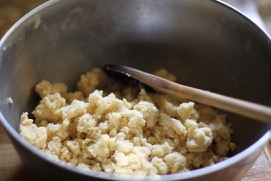
Making the dough. Mix flour with the sugar and the salt. Cut the cold butter into the flour with your finger tips, pastry cutter, knives or a food processor. If you are using a food processor, pulse for 10 seconds at a time, paying special attention not to over-process the dough. Stop when coarse crumbs form. The mixture should have pieces ranging from coarse crumbs to the size of small peas. Take water out of the freezer. Add 5 Tbsp of ice water slowly, 1 Tbsp at a time and mix until dough just holds together when pinched. Add more water only if needed. The mixture should retain a crumbly texture at his point; it should not be sticky. Again do not over-pulse the dough. If you are not using a food processor, you do not have to worry about over-processing that much, you’ll be most likely ready to stop. Do pay a close attention though what the dough should be like.
the crumbly dough
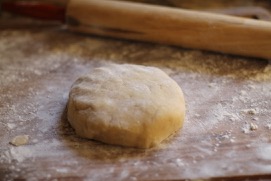
Shaping and chilling the dough. After making the dough, now it will be divided into two parts. Make sure the dough has all the loose pieces incorporated. Wrap each piece tightly with a plastic wrap and refrigerate at least for 1 hour or overnight. You can make this the day before and keep it in the fridge. This will help the crust to be flaky.
the dough wrapped in plastic
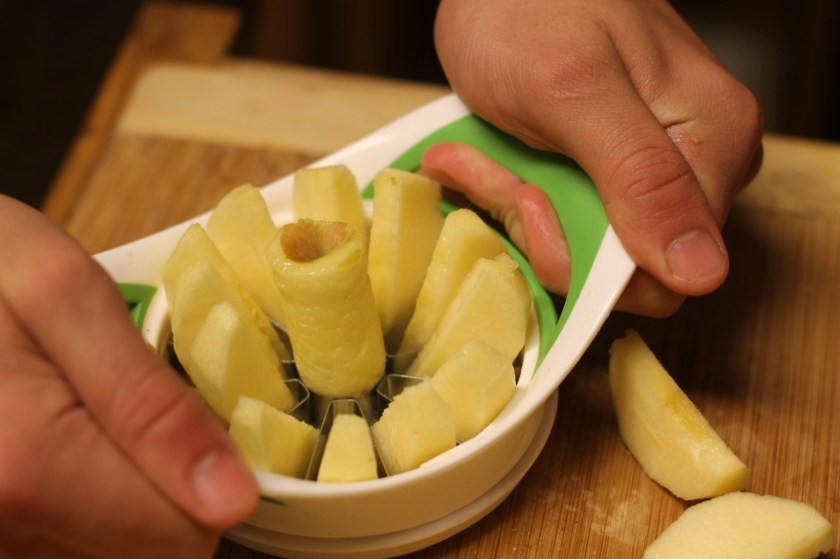
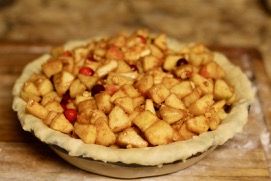
Preparing the filling. Wash, peel, core, and cut apples into 1/2 inch-thick slices. I like to use a mixture of baking apples for a more interesting flavor. I used 4 granny smith, 2 Cortland and 1 sweeter honey crisp apple. Add the orange/lemon juice and coat the apples well. Don’t add anything else to the apples until ready to assemble the pie. When ready add 1 cup of cranberries to get a more interesting flavor or add another apple instead. Then add everything else and mix. I happen to have an apple corer gadget, my daughter made me purchase a while ago. I have to say it was helpful for coring the apples but if you don’t have one, you don’t need to rush out to get one.
Assembling the pie. Your working area is supposed to be cold for this part. I just open the kitchen window while I’m doing this step and it should be cold enough.
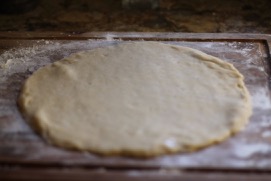
Take dough out of the fridge. On a lightly floured surface, roll out one disk of dough until 1/8 inch thick. I check the diameter by putting the bowl above the dough. I just eye it to see if the dough is large enough in diameter to cover the bowl. The finished dough should be about 1/2 inch bigger than the baking dish around.
The chilled dough
Roll dough around the rolling pin and unroll it over a 9 inch glass plate, pressing gently to fit into pan. Fill it with the apple mixture from above. Roll the other disk of dough in the same manner.
rolled out dough
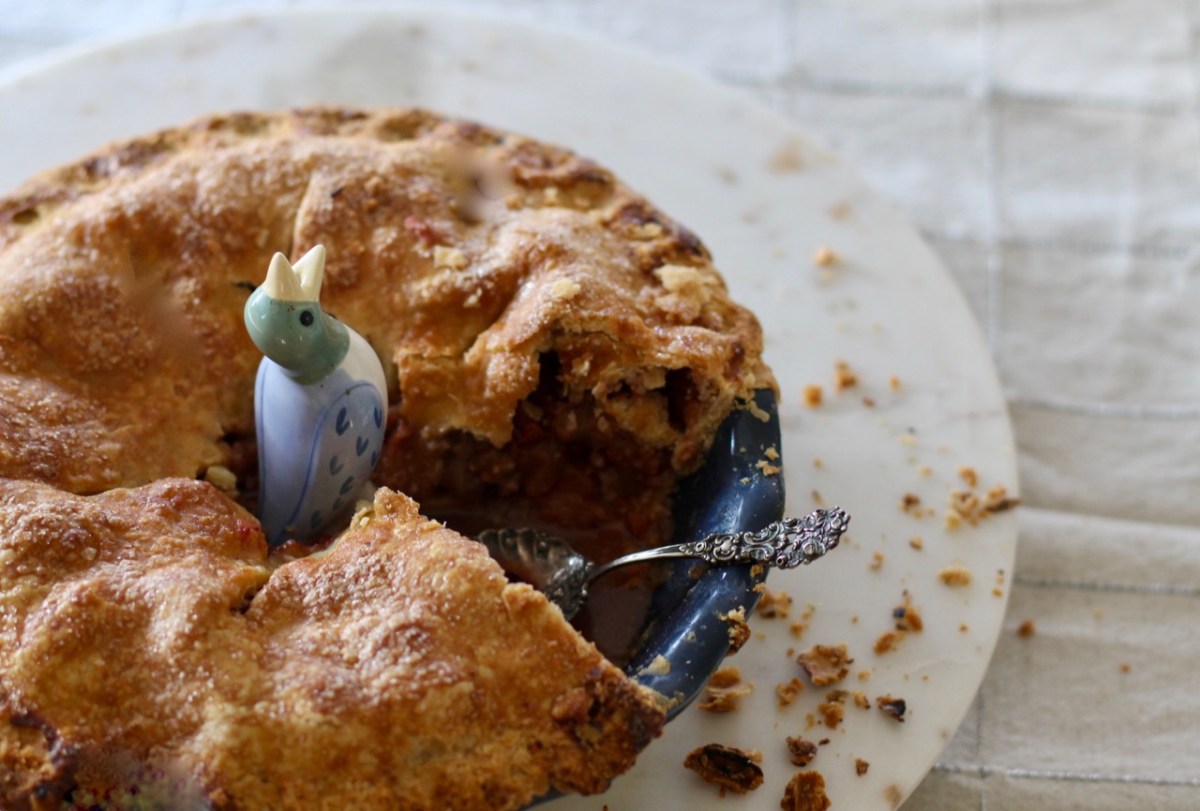
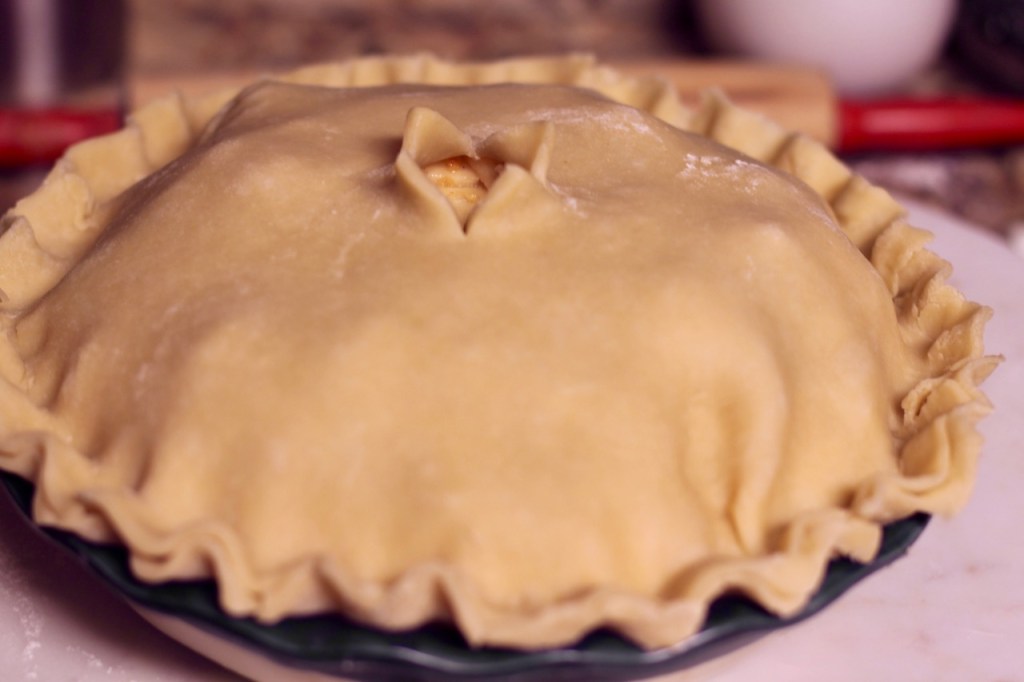
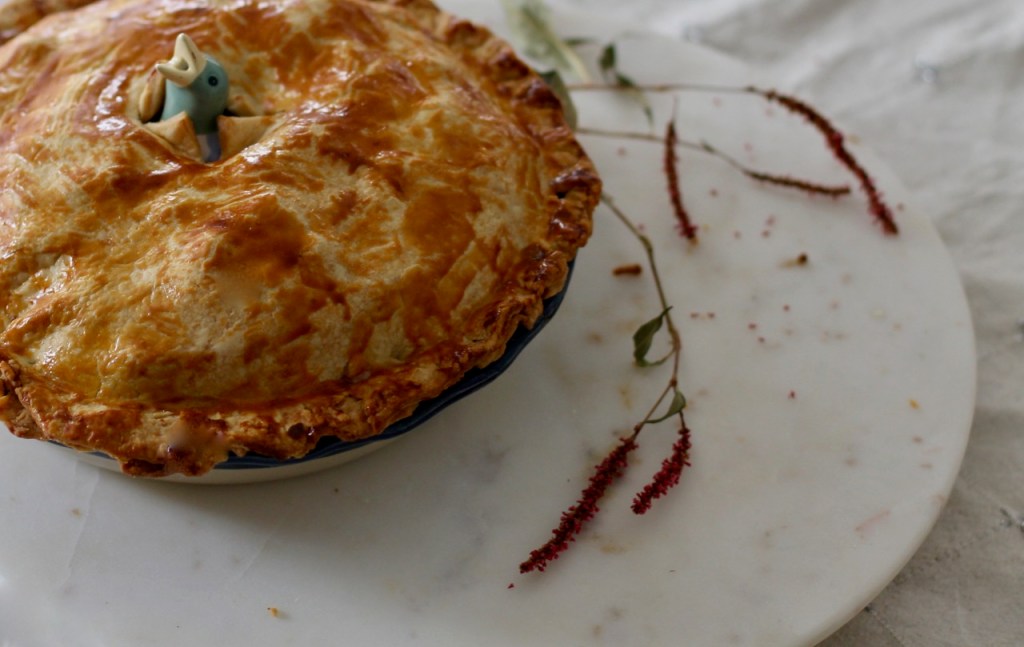
Drape over the bottom part. Use kitchen shears to trim overhang of both crusts to 1 inch. Press edges to seal. Fold overhang under and crimp edges: With thumb and index finger of your other hand, gently press dough against index finger of other hand. Continue around pie. Make several 3 inch slits in the top crust. This will allow the liquid to evaporate. I have a special clay bird that does this job. If you use the clay bird, you will not have to do this. If using the bird, cut 3 small slits in the middle of the pie, making an opening for the bird. Gently place the bird in and try to wiggle it around the apples. You can find these birds (see picture) at Williams Sonoma in the US -if anybody is interested.
Refrigerate the pie for 20 minutes. Preheat oven to 400 F.
Finishing the crust for baking. Whisk egg yolk and cream in a bowl; brush over the top of crust. Sprinkle the top with sugar.
Baking the pie. Place pie in preheated oven. Put a baking pan underneath to catch any liquid that escapes during the baking. Bake for 10 minutes. Reduce heat to 375 F. Continue baking until top and bottom crust are golden brown and juices are bubbling in the center for 70 to 85 minutes. Check on the pie after 1 hr and see if it is getting brown too quickly and needs to be covered with aluminum foil.
When ready, take the pie out and let it cool on a wire rack for at least 4 hours before serving. If you are not eating it all the same day, leave it on the counter loosely covered. Do not store in the refrigerator, the dough will get soggy.
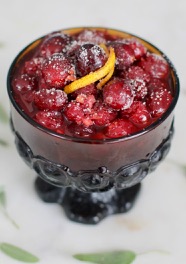
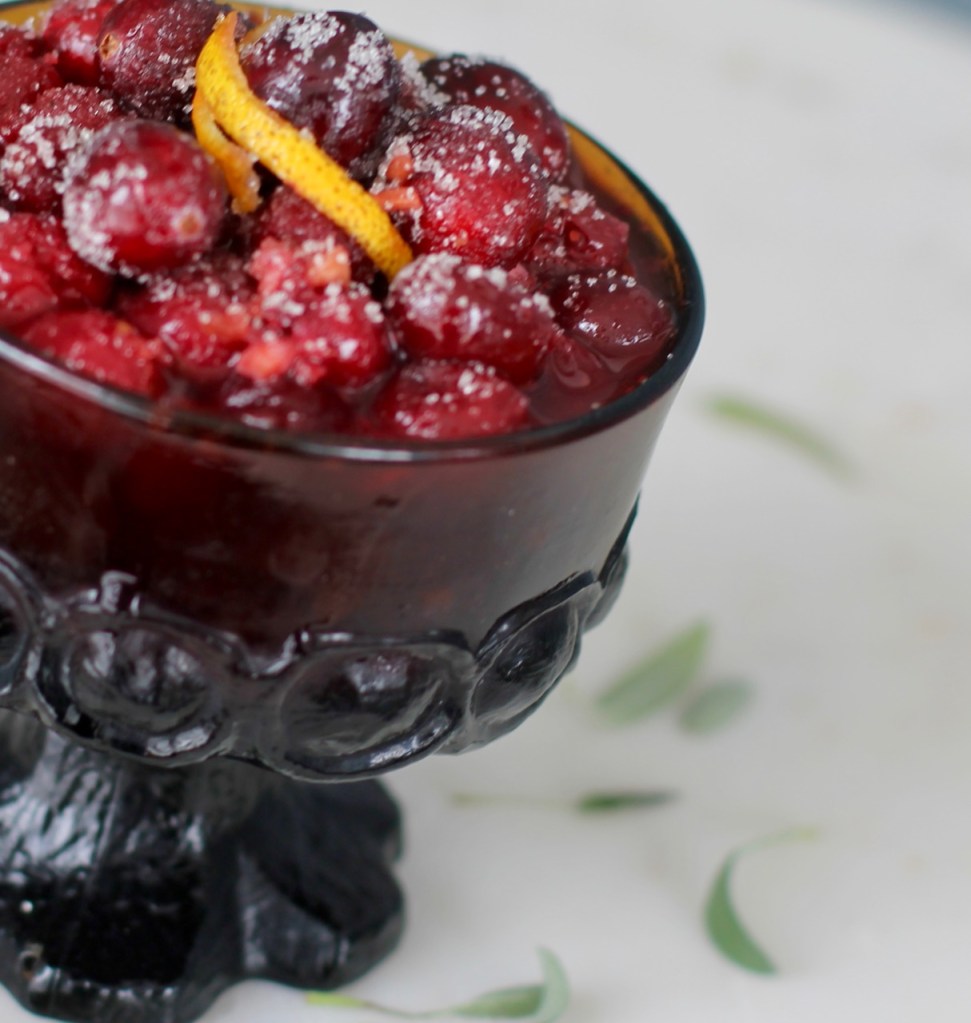
According to my mother-in-law, a good cranberry sauce should have whole cranberries and a nice sauce, so as to not be mushy or dry. I created this cranberry sauce keeping this in mind. It is gently infused with oranges and pungent spices and is slowly baked in the oven. In addition, the alcohol will elevate it to another level that gives an unexpected kick to the sauce. It will go nicely with any savory fall or winter dishes. You don’t have to wait until Thanksgiving, go ahead and you can try it now!
I really like how this cranberry sauce turned out. Here is my little story… As a foreigner I did not grow up eating cranberries so I have been relying on the Joy of Cooking cookbook for the recipe. I was contemplating whether to make some changes to the basic recipe or just let the cranberries be what they are and enjoy their true taste.
I started experimenting. First, I put the oranges to the test. Why add oranges, another bitter fruit?!? OK orange peels are bitter but are also sweet. I found that the sweet oranges paired nicely with the sour cranberries. Perhaps because their common denominator is the bitterness ?!?
In the culinary world, it is well known that pungent spices offset the sour flavors so I also added cinnamon, ginger, nutmeg, allspice. They bring a little warmth to the sauce, too. In addition, the allspice gave a nice citrusy flavor. They balanced out the sauce nicely and resulted in a pleasant sweet and sour dish. Again, I can’t imagine the sauce without them.
Oh and the sugar! Most recipes use sugar for cranberry sauce; after all it is a sour dish and sweet can offset sourness. I have nothing against sugar if used well in a dish, meaning it does not overpower the foods that it is added to. I am excited to say that I was able to reduce the sugar a bit in this recipe just by adding the seasonings. Not bad ehhh …
There is more! I used to cook the sauce in a pot that yielded a rather mushy appearance. It did not bother me, I did not even realize I did not cook the cranberries properly. To make sure the cranberries stayed whole, my mother-in-law used to prick each berry one by one with a needle so they didn’t burst open in the pot. I have recently learnt from a chef that slowly cooking them in the oven would give very nice results and the berries stay whole. I would like to mention that of course cranberries carefully made in a pot can stay whole as well.
I think my recipe made the cranberries more suitable to eat with savory foods, it has a pleasant flavor without overpowering the cranberries. You can keep it in the refrigerator for at least 1 week. The flavors come together while the sauce sits in the fridge. Hope you will enjoy it! Of course, there are many other techniques to cook cranberries that yield beautiful results too.
Cranberry sauce recipe
Serves 2-3 people.
Ingredients
1 cup of fresh cranberries (frozen is fine just make sure they are fully defrosted)
1/4 cup of sugar
1 tsp dried ginger (cut and sifted) or 2 tsp fresh ginger (chopped)
1 orange (chopped up peel and the juice) Chop up the orange peel into very small pieces it tastes great in the sauce or 2 Tbsp dried orange peel and 1/3 cup of orange juice
If you don’t have orange juice you can use 1/3 cup of other juices or even water and maybe even a little orange essence
1 cinnamon stick
3 pieces of all spice berries
1/8 tsp freshly ground nutmeg
few pink pepper corns
1 Tbsp of spirit of your choice: whiskey, fruit brandy (optional)
touch of freshly ground black pepper and salt to be added at the end
Directions
Wash cranberries, discard any with blemishes. Combine all ingredient in a baking/glass dish and wait until cranberries start releasing their liquid for about a half an hour. Set oven to 250 F and slowly bake for about two hours. Cranberries are ready when nicely cooked but not raw or mushy.
When done take the dish out of the oven and remove the larger spice pieces (cinnamon, allspice, pepper corn).
Add the salt and the pepper.
Serve at room temperature.
You can triple this recipe for Thanksgiving for 9- 10 people.
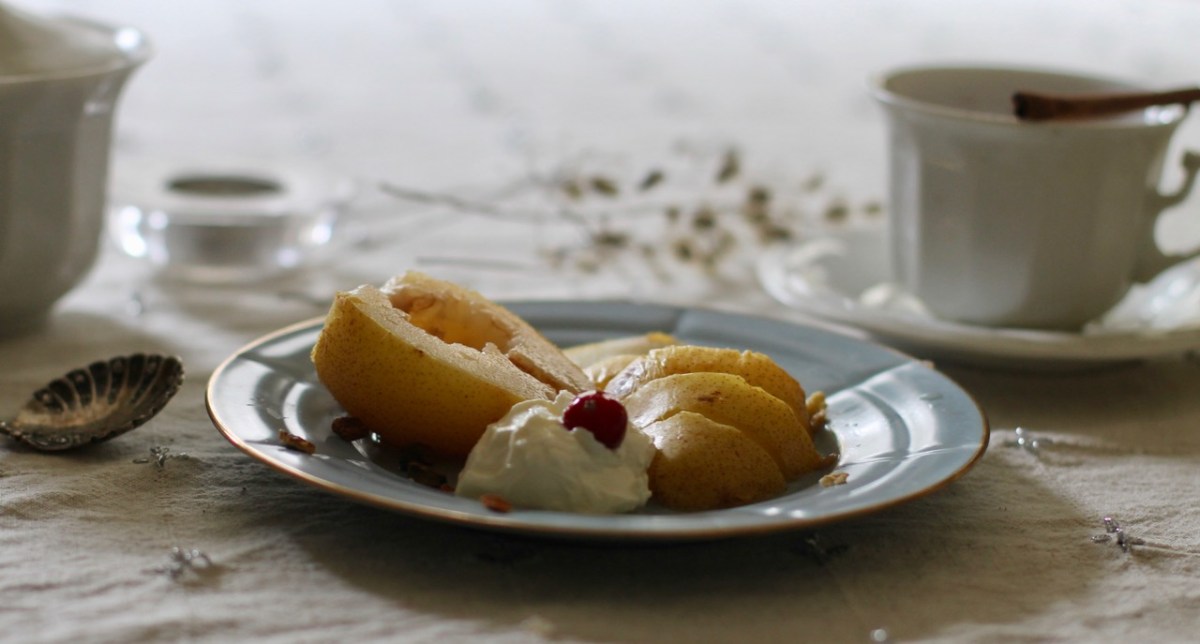
You get two for one with this recipe! There are the fabulous poached pears and also you get to enjoy its delicious liquid as a tea. They can be served for the holidays to delight your guests. You can also serve them any time when you need a little boost in the fall. As a practitioner of Chinese Medicine, I like creating individualized teas for people but it is also gratifying to come up with fun seasonal teas as well. This fall drink is no exception.
The sugar is caramelized, the warming spices are gently infused and the sweet pears are added at the end for poaching. The end products are the firm poached pears that can accompany any fall dish and this wonderful light drink that warms your body and soul. You can surprise your guests for Thanksgiving dinner with these delicious treats!
The sweet and juicy pears are also valuable for health. They are cooling and slightly acidic. They help the lungs by moving stagnation and keeping them moist during the dry season. They are high in fiber that is very much needed in the fall. Pears are also good source of antioxidants, minerals like copper, iron, potassium, manganese, magnesium and vitamins A, B, and C.
Recipe
INGREDIENTS
2 Qt of cold water
3-4 larger firm but ripe pears (Bosc, Bartlett). You can poach more pears in this liquid. You can leave the stems attached if they have stems.
1/8 -1/4 cup of sugar
1 Tbsp Mulling spice (please see below)
zest of lemon peel
3 slices of an orange (optional)
pinch of salt
maple syrup or caramel sauce, optional
Method
Place 2 Qt water along with the sugar in a medium size pot. Bring to a boil, this will caramelize the sugar.
Turn the heat down and simmer the spices for 10 minutes. I chose cinnamon, all spice, orange peel, ginger, cloves, cardamom. It is a good idea to set a timer, time is important here. Please see the recipe below.
Meanwhile wash the pears. You can peel them and cut the bottoms of the pears off or just leave them as they are.
Turn off heat completely and add the pears into the pot. Keep them in the steam for about 5 – 10 minutes. The pears will poach in the steam. You want your pears to be soft but not mushy.
Serve the poached pears with dinner or own its own as a dessert with maple syrup or caramel sauce. Keep the liquid for a delicious warming drink.
Mulling spice
1 tsp cinnamon chips
1 tsp allspice berries
3 pieces of cloves
1 Tbsp dried orange peel
7 cardamom seeds
1/2 tsp of dried ginger root (cut and sifted) or 1 tsp fresh ginger root
I don’t think it is an accident that stuffed cabbage is a Christmas dish. You can surely serve it any time but it is the perfect dish for the holidays.
I smile every time I remember my daughter’s reaction. She was three years old when she saw stuffed cabbage on the Christmas table and screamed ‘YUCKY’. However, after she tried it, she realized how delicious it was. Ever since then, she makes sure that it is on the Christmas menu every year.
Stuffed cabbage is a popular winter dish in Hungary even though our ancestors didn’t make it. It is a dish that was inspired by the Turks. They called it szárma from the Turkish word sarma. However, many of us today can’t imagine Christmas without it. My mom made it every year.
I don’t think it is an accident that stuffed cabbage is a Christmas dish. You can surely serve it any time of the year but it is the perfect dish for the holidays. In the old days, families butchered their pigs and the meat was ready to be used by around this time. Also, there weren’t too many vegetables available except for a few like cabbages and onions. Not to mention that the dish can be kept in the cold for a couple of days. In fact, it tastes the best after a few days. This was an important consideration too. Christmas went on for days back in the old times. According to traditional customs, people were not allowed to work during the celebrations.
The recipe is not too difficult, though it is time-consuming. Just remember you won’t have to cook for 3 days afterwards! There are many variations of this recipe but this is how I make it. Please feel free to experiment with it.
What you need
Meat stock:
1 -2 lb of beef bones (ox tail and beef bone)
2-3 Tbsp of black pepper corn. I like to add a lot of peppercorns because they give a really nice flavor to the dish.
water
4 bay leaves
3 carrots
2 parsnips
1 large onions
few cloves of garlic
2 celery stalk or 1 medium sized celery root
For the cabbage rolls:
high quality oil (lard, sunflower seed oil)
1 1/4 lb of ground pork (can be half beef)
oil
1 larger onion, chopped
2 slices of bacon, sliced (optional)
2 cloves garlic, crushed
2 lb of sauerkraut, drained, divided
few strings fresh thyme or 1 tsp dried thyme
1 cup of uncooked rice, cleaned
1 cup of cold water to cook the rice in
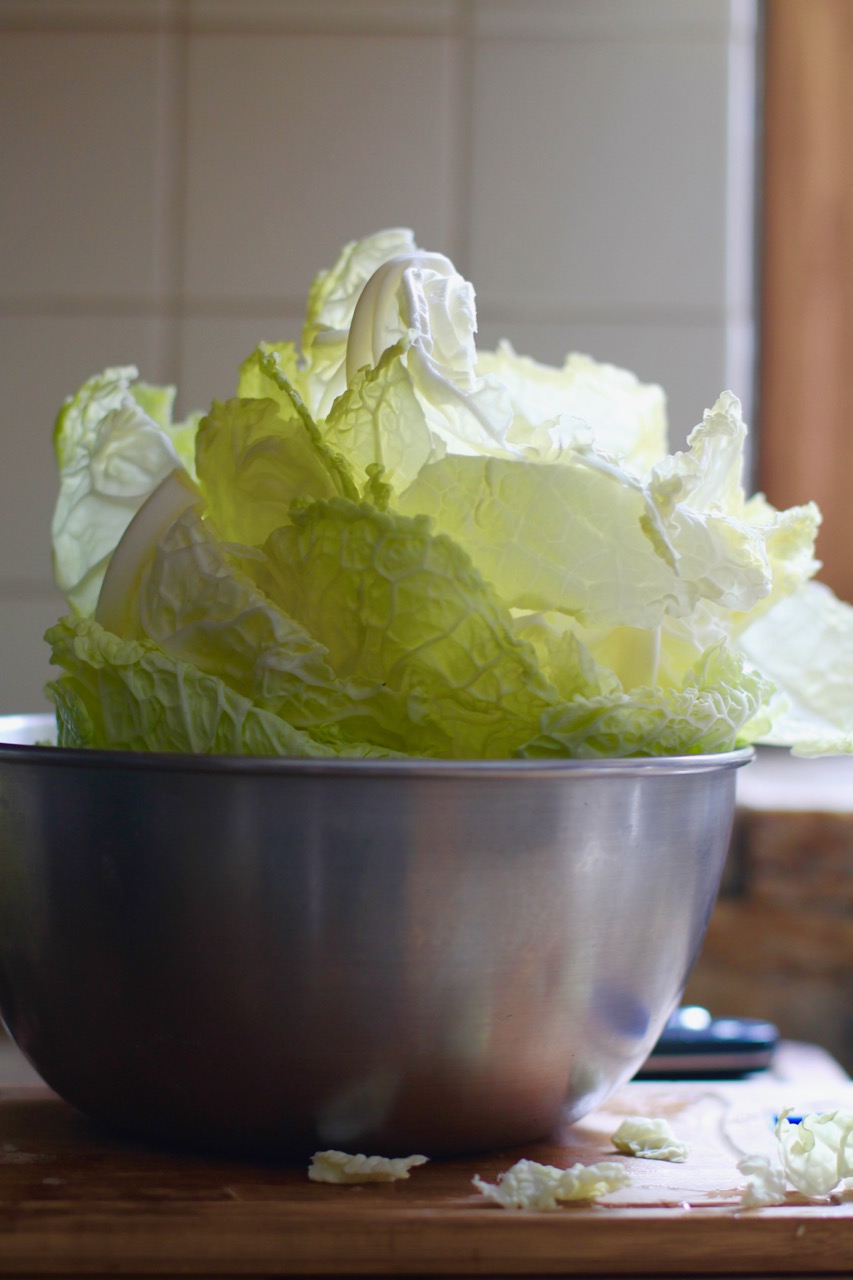
1-2 heads of large Savoy cabbage or green cabbage or sour cabbage leaves (about 18 – 20 leaves)
marjoram
2 tsp sweet Hungarian paprika (make sure it is authentic)
1 egg
sour cream
freshly ground black pepper and salt to taste
Hot pepper flakes or Erös Pista to taste
smoked meat like kielbasa, sausages (optional)
Preparation
twincitiesherbs.com
Meat stuffing
the cabbage roll
Meat stock.
Place the onion, beef bones, pepper corns, garlic, carrots, parsnips, bay leaves , celery in a large pot. Add enough water to cover everything. Bring to a boil, turn the heat down and slowly cook for 2- 4 hours covered. Set aside. (Omit if you already have it).
Making the dish.
Preparing the base of the dish. Sauté the onion in oil on medium high heat for 10 minutes or until translucent. Add bacon if you desire and cook for 5 more minute or until the bacon looks crisp. Add paprika, stir for 1 minute. Add a little cold liquid (have it ready) and stir. Add 1 lb of the sour kraut. Mix. Set aside.
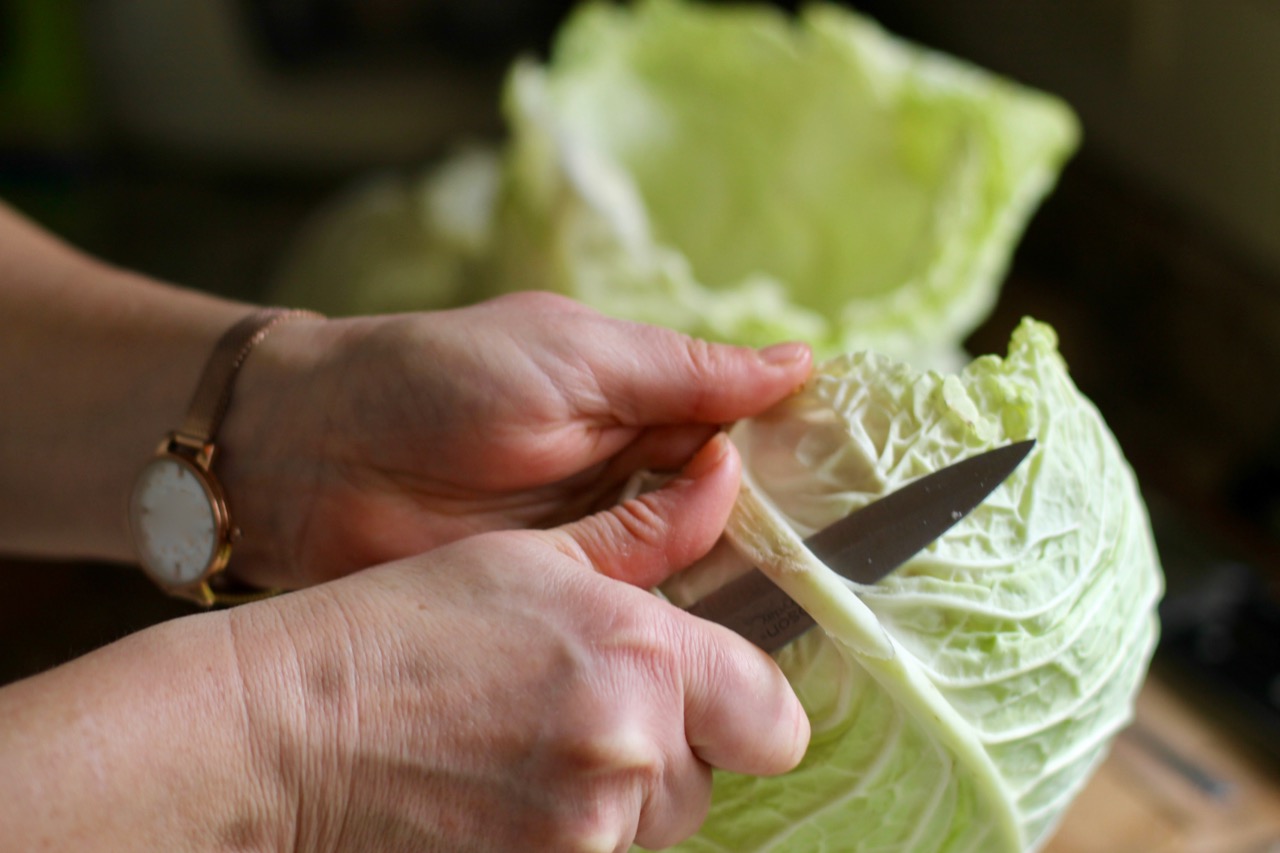
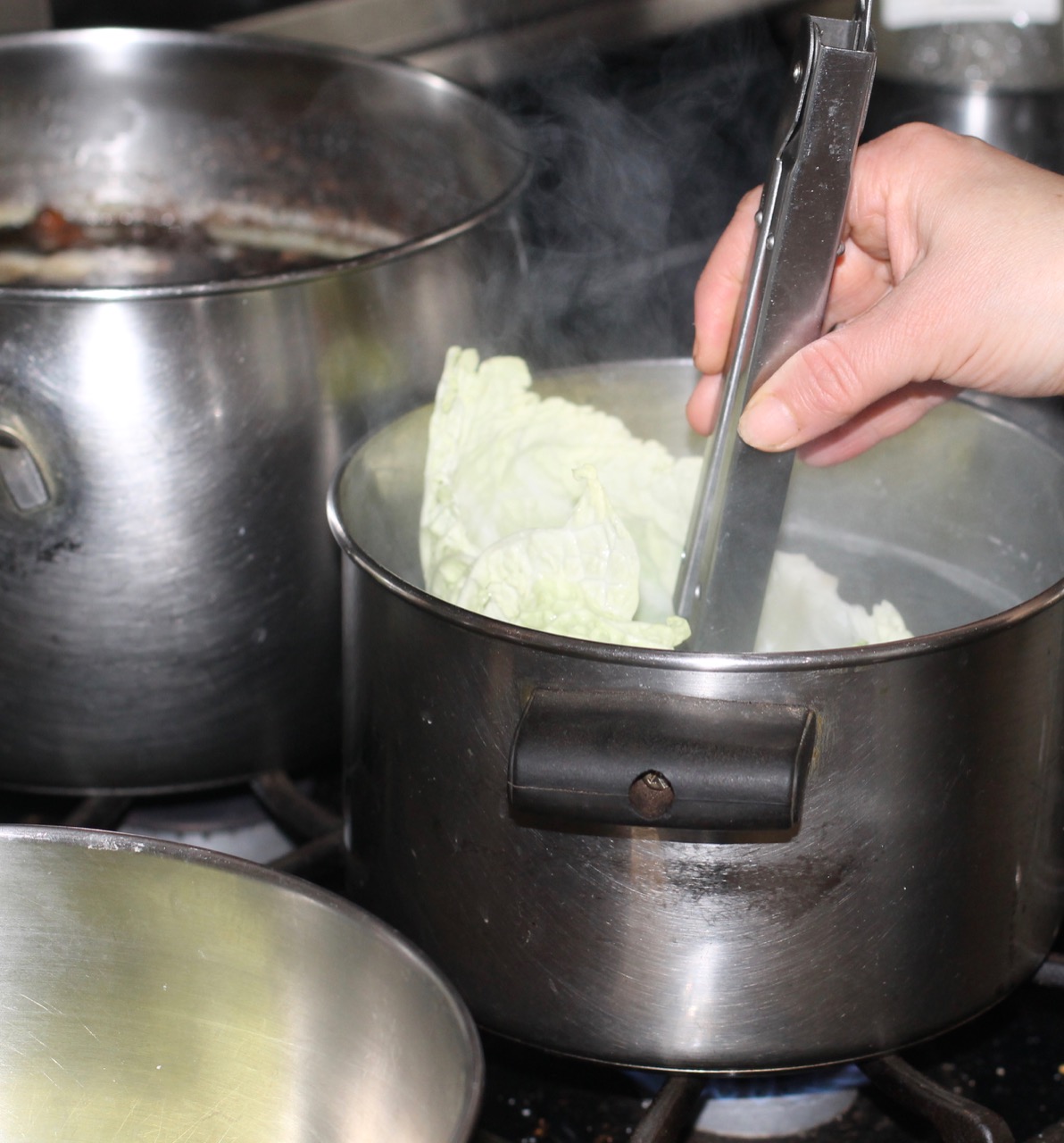
Preparing the cabbage leaves. Fill a larger pot with cold water and start boiling it. This will be used to soften the leaves. Take the leaves off the cabbage gently one by one. When the water boils, add the leaves in the boiling water one at a time for a few minutes. Here we are parboiling the cabbage leaves so make sure they get semi soft but not mushy. (Omit if you have sour cabbage leaves).
Preparing the rice. Bring 1 cup of rice in 1 cup of cold water to a boil. Turn the heat down to low heat and cook uncovered for 10 minutes. Set aside.
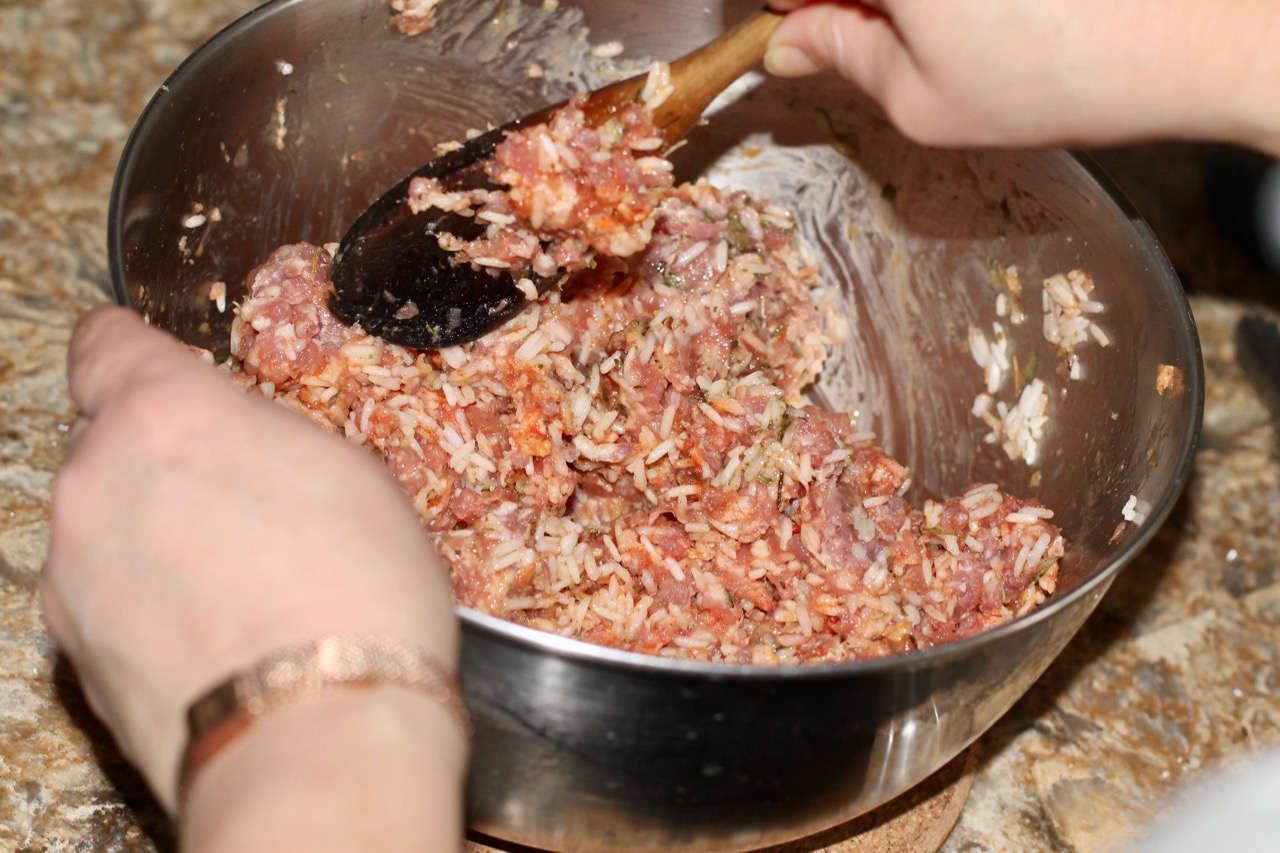
Preparing the stuffing. In a medium sized dish, mix the cooked rice from earlier, crushed garlic cloves, marjoram, 1 egg and the meat together. Set aside.
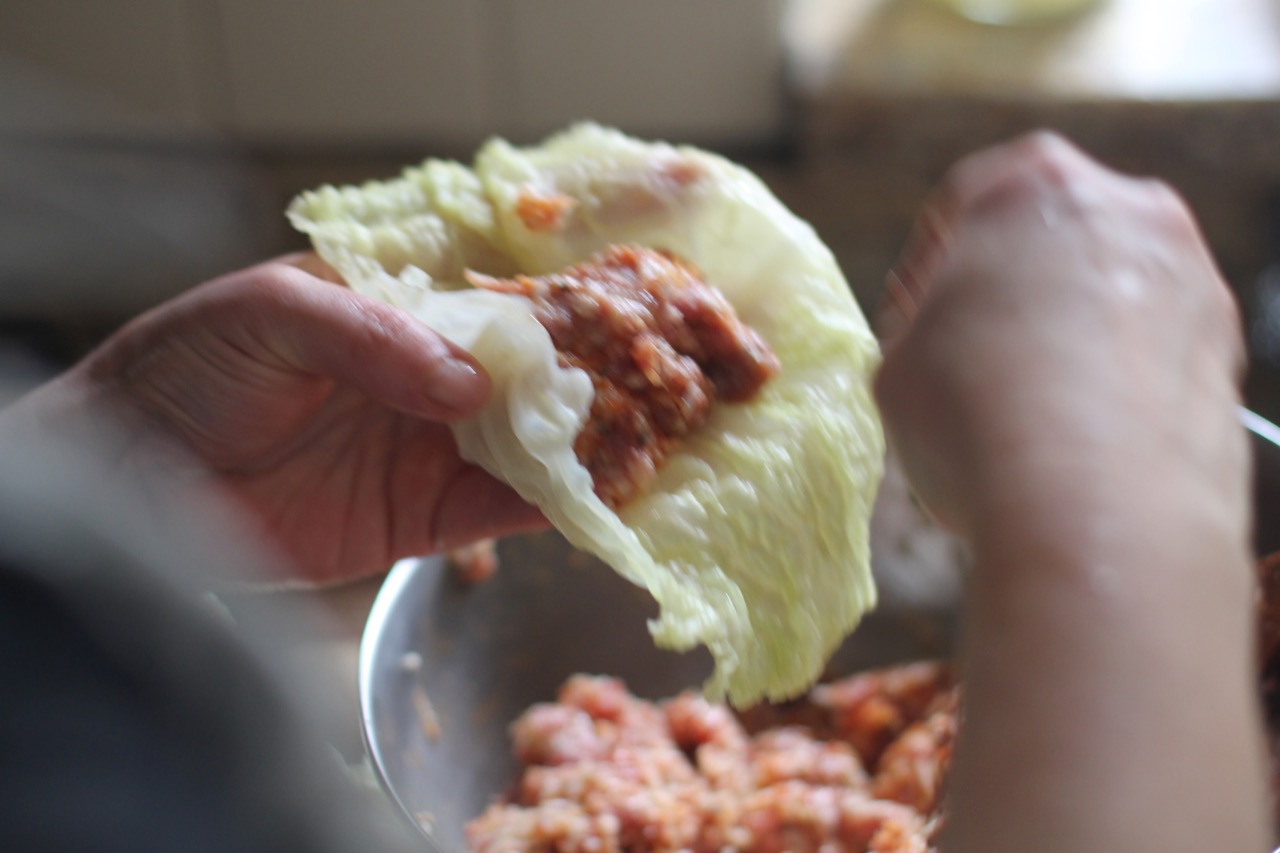
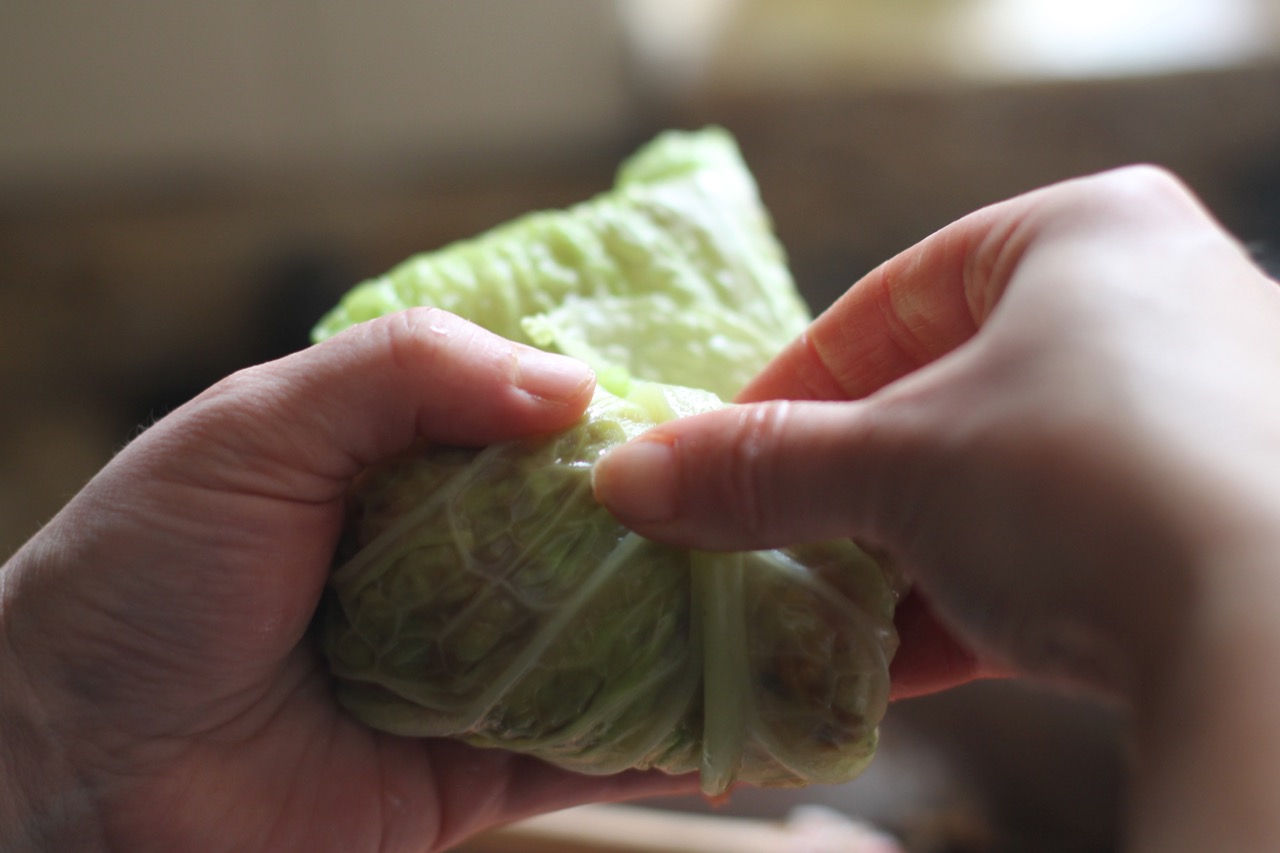
Assembling the stuffed cabbages. Fill the cabbage leaves in the middle with about 1 heaping tablespoon of stuffing or more if leaf is bigger and fold them on all four sides so the stuffing is tucked inside the leaves nicely. Be careful you don’t fold them too tight because the mixture will expand a little. You can close the leaves with a toothpick if you want but it is really not necessary. This may sound like a difficult task but really what you do here is you tuck the filling inside the leaves and fold each side onto the stuffing so it is nested inside the leaves. Please, see the pictures for clarification above.
Place the assembled cabbages on top of the prepared sour kraut mixture from earlier one by one, fitting each leaf snug next to each other. Place the remaining 1 lb sour-kraut on top of the stuffed cabbages.
Pour the meat stock over the stuffed cabbage leaves. Make sure the liquid covers everything in the pot. Bring to a boil and turn the heat down. Cook on very low heat slowly covered for 1 ½-2 hours or until the cabbage and the stuffing are cooked.
Add salt and pepper to taste.
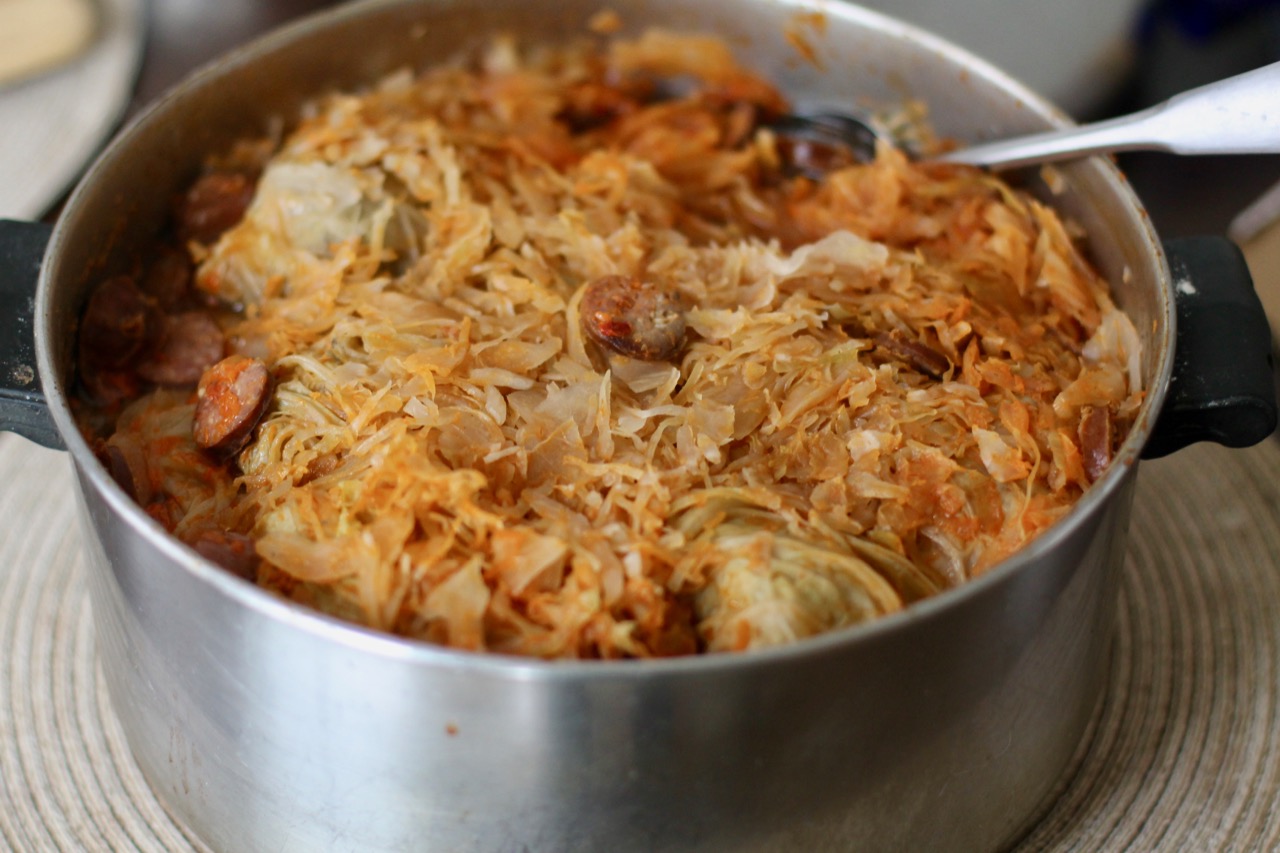
Serve the stuffed cabbages on top of the sauerkraut along with sour cream, sliced kielbasa and hot red pepper flakes or Erös paprika.